Roman Standards & Standard-Bearers (1) by Raffaele D'Amato & PETER DENNIS
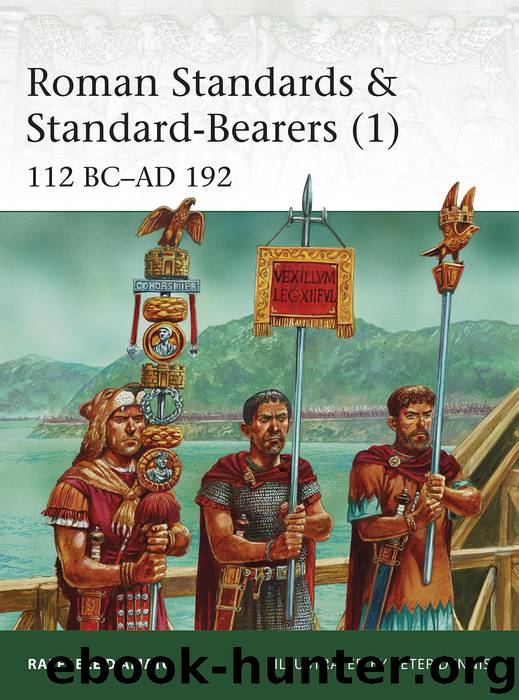
Author:Raffaele D'Amato & PETER DENNIS
Language: eng
Format: epub
ISBN: 9781472821812
Publisher: Bloomsbury Publishing
Published: 2017-09-24T16:00:00+00:00
IMPERIAL GUARD STANDARDS
Praetorian cohorts
In the Imperial Guard, Praetorian cohorts had signa manipulorum until the suppression of the maniple under Hadrian. Each centuria of each Praetorian cohors had its signifer, as well as the cohort itself, although we cannot exclude the idea (discussed above) of a standard serving a double function as the signum cohortis and senior signum centuriae.
Imperial Guard standard-bearers escorting an emperor are mentioned with regard to the death of Galba by both Tacitus (Hist., I, 41) and Plutarch (Galba, XXVI, 4): ‘the vexillarius of the cohort escorting Galba – it is said that his name was Atilius Vergilio – tore Galba’s portrait from the standard and threw it on the ground’.
This passage is confirmed by the iconography. The Praetorian signa represented on Trajan’s Column and on the Great Trajanic Frieze (Villa Borghese) bear the imago of Trajan on their phalerae, combined with crowns, eagles in laurel wreaths, and lunulae. In a fragment from the Villa Borghese the three signa have a different composition: at the bottom they have the same tassel and wreath, but reading upwards from these the central standard shows a mural crown, a second wreath/crown, a damaged imago, another wreath/crown, and at the top an aquila standing on a fulmen. On the right-hand standard, again reading upwards from the lower wreath, there are an imago, a mural crown, another imago, another wreath/crown and, at the damaged top, two vertical elements perhaps representing the down-turned wingtips of an eagle. On the last standard, the upwards sequence above the wreath is an empty imago, another wreath/crown, a mural crown, and at the apex a hand. Behind the symbols at the top are fastened crossbars with hanging side-straps. The presence of the manus suggests that this kind of signa were employed as signa manipulorum/signa centuriae.
According to the sources, on the standards of the Imperial Guard the images were displayed on medallions. This was the main distinction between Praetorian signa and those of the legions and auxiliaries, where the Imperial imago was carried by the imaginifer, and phalerae cum imagines were only rarely displayed on the other standards after the last quarter of the 1st century AD. The bond between emperors and Praetorians was notably strengthened under the Flavian dynasty, when the signa of the Praetorians were at least partially renewed. This is confirmed on the base of the Column of Antoninus Pius, where the imagines of the whole Imperial family are inscribed into two medallions on each signum, displayed on the shaft between decorative tassels.4
For the rest, on Praetorian standards we can identify either phalerae of plain patera shape or phalerae cum imagines, combined with crowns. These include round gold coronae murales (shaped like the walls of a city, and awarded for successful siege operations); similar but possibly square-section coronae vallares or castrenses (scenes IV–V of Trajan’s Column); coronae civicae; and coronae navales, sometimes incorporating a ship emblem (Trajan’s Column, scene CIV). Some samples of such combinations on the Praetorian signa visible on the Column are as follows
Download
This site does not store any files on its server. We only index and link to content provided by other sites. Please contact the content providers to delete copyright contents if any and email us, we'll remove relevant links or contents immediately.
| Africa | Americas |
| Arctic & Antarctica | Asia |
| Australia & Oceania | Europe |
| Middle East | Russia |
| United States | World |
| Ancient Civilizations | Military |
| Historical Study & Educational Resources |
Room 212 by Kate Stewart(5198)
The Crown by Robert Lacey(4878)
Endurance: Shackleton's Incredible Voyage by Alfred Lansing(4861)
The Iron Duke by The Iron Duke(4419)
The Rape of Nanking by Iris Chang(4274)
Joan of Arc by Mary Gordon(4167)
Killing England by Bill O'Reilly(4062)
Say Nothing by Patrick Radden Keefe(4057)
I'll Give You the Sun by Jandy Nelson(3512)
Shadow of Night by Deborah Harkness(3429)
Hitler's Monsters by Eric Kurlander(3410)
Eleanor & Park by Rainbow Rowell(3269)
Blood and Sand by Alex Von Tunzelmann(3255)
Mary, Queen of Scots, and the Murder of Lord Darnley by Alison Weir(3252)
Darkest Hour by Anthony McCarten(3183)
Margaret Thatcher: The Autobiography by Thatcher Margaret(3128)
Book of Life by Deborah Harkness(2993)
Red Famine: Stalin's War on Ukraine by Anne Applebaum(2977)
The One Memory of Flora Banks by Emily Barr(2909)
